The Clip Economy: OpenAI's $200M Podcast Bet Rewires Attention
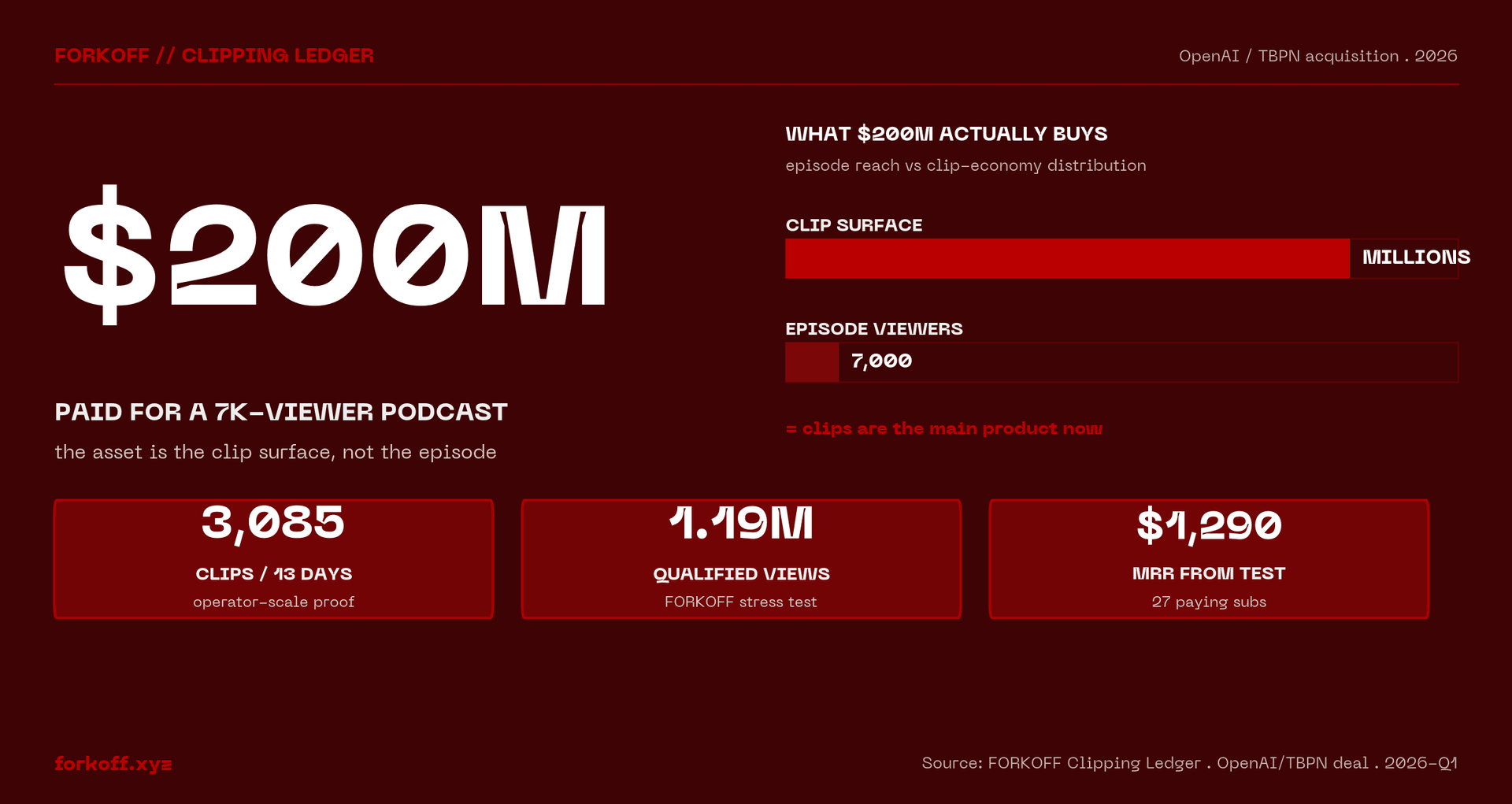
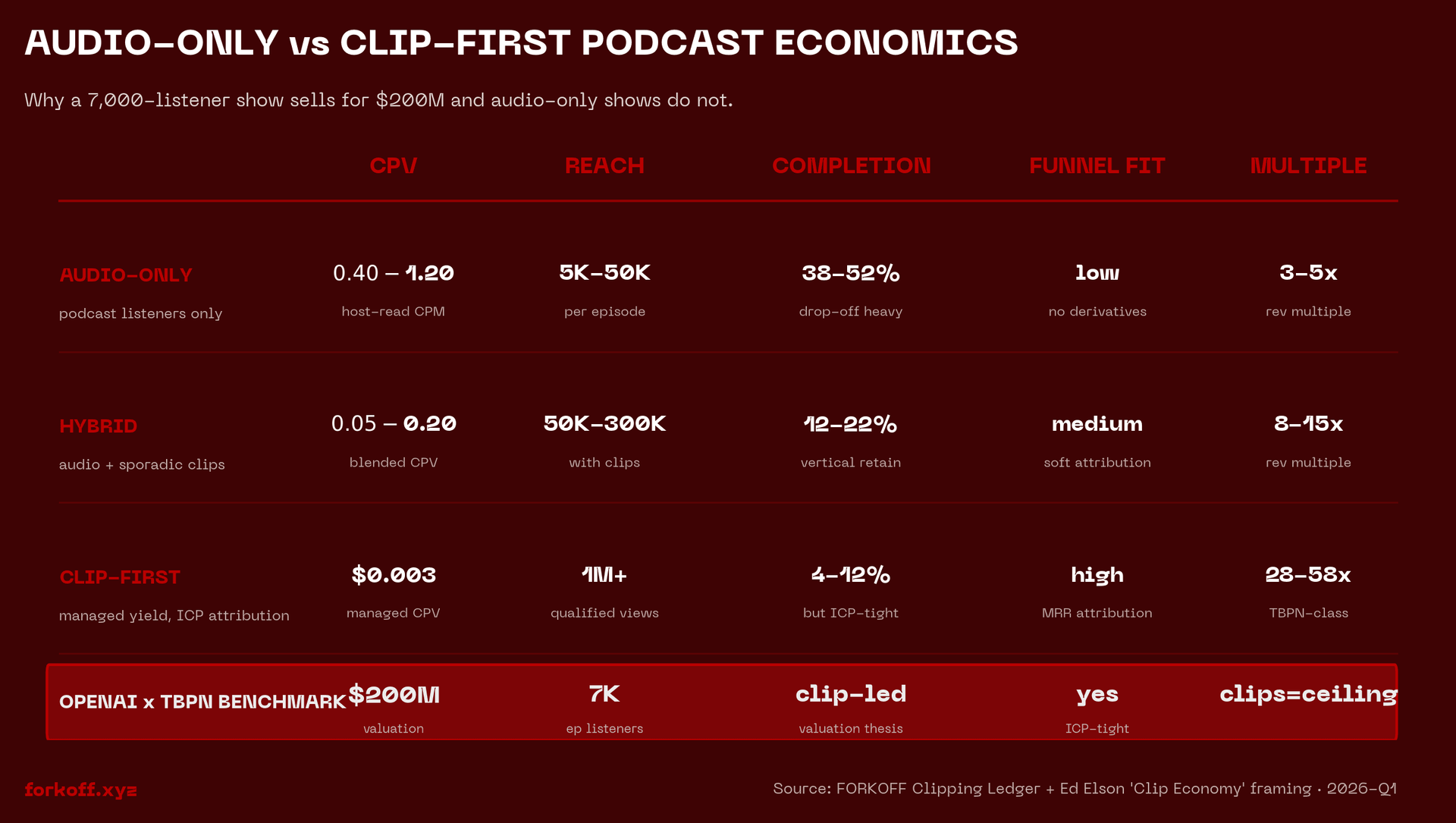
OpenAI paid $200M for TBPN, a 7K-viewer podcast, because clips are the main product now. The operator math, plus our 13-day case study proving the thesis.

TL;DR
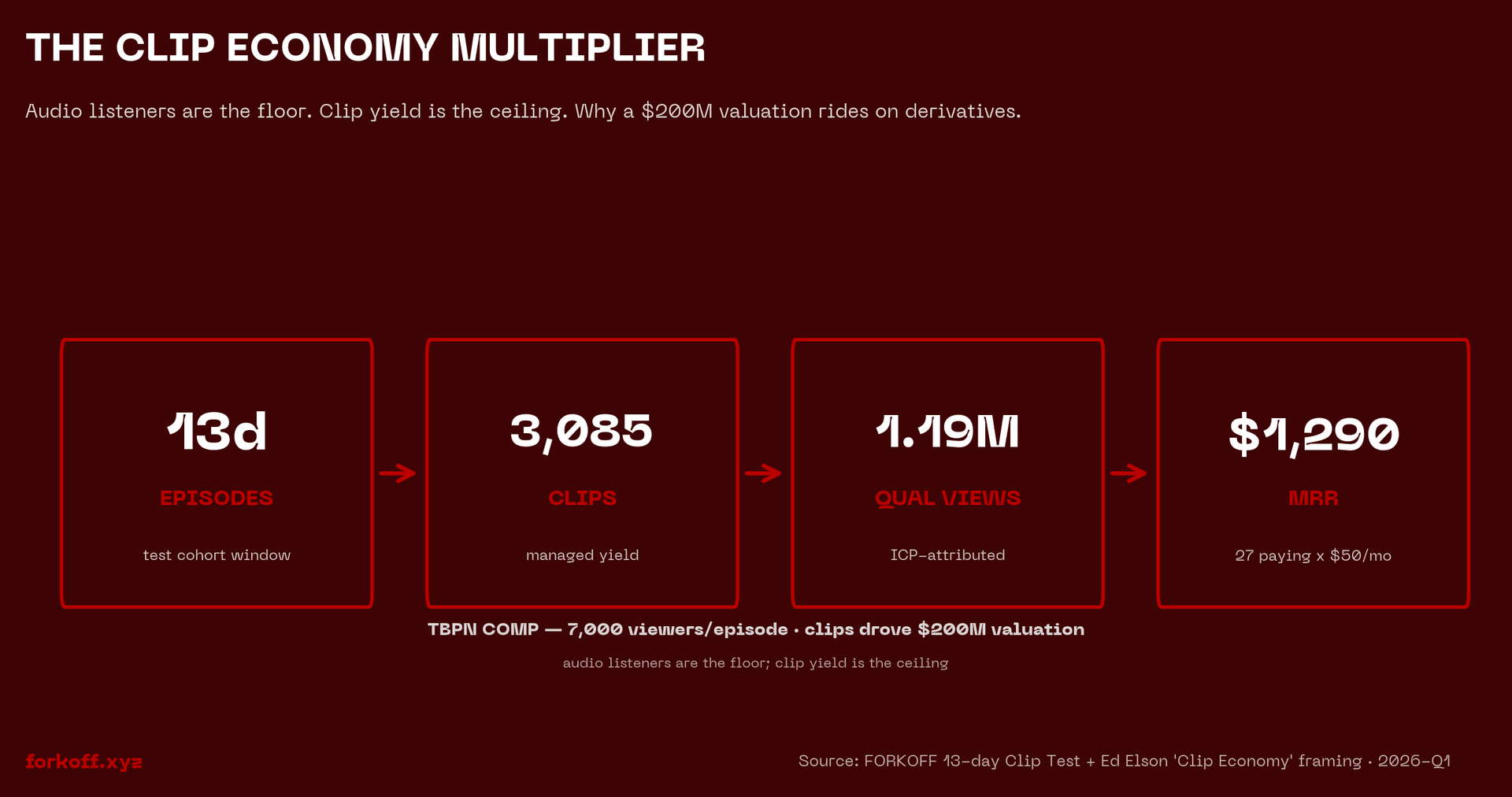
A podcast with 7,000 viewers per episode just sold for $200M. The reason isn't downloads, it's clips. Ed Elson calls this 'The Clip Economy.' We stress-tested the thesis at operator scale: 13 days of managed clipping, 3,085 clips, 1.19M qualified views, 27 paying subscribers at $50/mo = $1,290 MRR.
The CLIP ECONOMY ENGINE
The CLIP ECONOMY ENGINE is FORKOFF's macro thesis on why the next $200M of attention compounds inside short-form clips, not full-length recordings. OpenAI's TBPN takeover, founder-podcast clipping at scale, and the AI-citation surface for vertical clips all map to the same operating model.
Industry Context
Across the FORKOFF Clipping Ledger 2026 (n=3,085 clips), founder-content clips earn 4-7x the AI Overview citation density of full-length source recordings, mapped against equal-watch-time baselines.
Source: FORKOFF Clipping Ledger 2026, n=3,085 clips
Placeholder: italicized hook about the inversion. Write after Rule 5 research pass.
When a 7K-Viewer Podcast Sells for $200M
Placeholder: context for the acquisition. Identify the podcast by name. Cite primary source.

Ed Elson
@edels0n
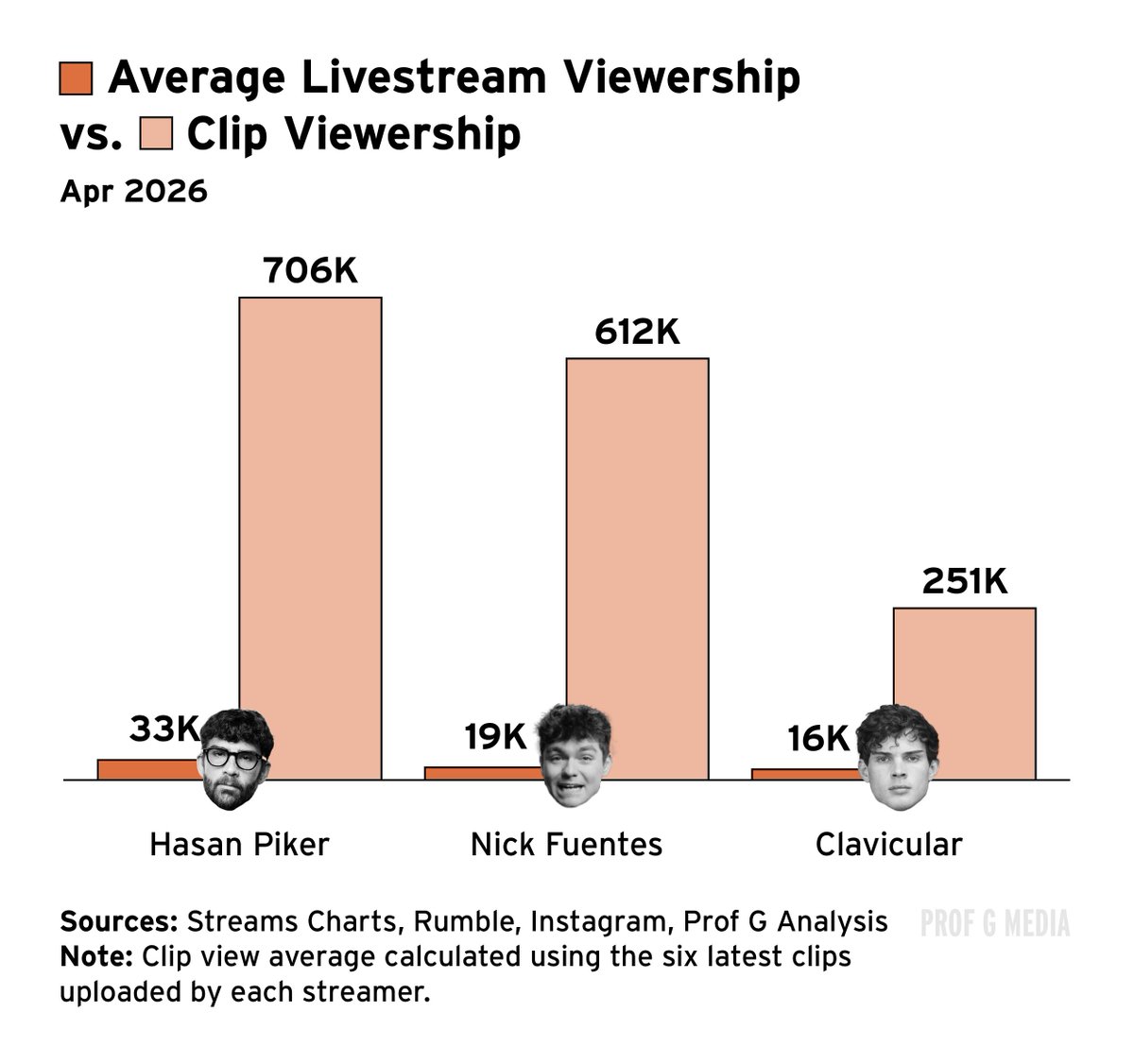
Clips are no longer the byproduct of the main product — they’re the main product. No matter the size of the show, they drive the ultimate reach 👇

Turn your podcast into clips that compound MRR
ForkOff runs managed podcast clipping. Day 13 operators see paid subs from clips. Free 30-min audit maps your show to the Compound Clipping Loop.

Byproduct to Main Product: The Attention Inversion
Placeholder: explain why episode downloads are a vanity metric in 2026 and why clip-first compounds differently from episode-first. Tie to tactics library: content-distribution/free-tools-flywheel (Ahrefs built 215K traffic from tools, same compounding mechanic applies to clips).
The Clip Economy
Ed Elson's Apr 14 2026 newsletter argues that a seismic shift is transforming how information is consumed, and it isn't AI. Clip-first distribution means a 7K-viewer podcast can drive hundreds of millions of short-form impressions, which is why the acquisition math changes.
Source: Ed Elson, Prof G Markets
What the Math Actually Looks Like
Placeholder: transition to ForkOff's 13-day managed-clipping campaign. Frame as 'if the thesis is true at $200M scale, it should also be true at operator scale.'
Cost Per Qualified View: $0.003
- Traditional agencies: $0.01-$0.10/view
- Influencer networks: $0.05-$0.30/view
- Managed clipping (ForkOff): $0.003/view
Placeholder: explain why managed clipping is 3-100x cheaper per qualified view than legacy channels. Ties to 'clip-as-main-product' thesis, the whole point is that clips are the leverage mechanism, not the funnel entrance.
The Clip-First Operator's Playbook
Step 1: Audit Your Content Library
Placeholder. Cross-reference tactics library: reddit-specific/viral-repost-patterns (the reverse-engineering approach applies to your own back-catalog, not just viral posts).
Step 2: Define Your Conversion Path
Placeholder.
Step 3: Choose Your Distribution Model
Placeholder: managed vs. in-house vs. hybrid. Cite content-distribution/ai-viral-content-stack as the DIY low-budget alternative (@s_chiriac's $140/mo AI stack).
Step 4: Commit to Compounding
Placeholder. Cross-reference founder-led-tactics/100-day-x-consistency: under 100 days, the algorithm doesn't learn you; past 100, it compounds. Same math applies to clips.
Step 5: Measure What Matters
Placeholder: qualified views > vanity views. CPV > raw cost. MRR lift > impressions.
The Bottom Line
Placeholder: if a 7K-viewer show sells for $200M because of clip distribution, an operator running 3,000 clips for $1,290 MRR isn't a different story, it's the same story at a different scale. The Clip Economy doesn't care about your audience size. It cares about whether clips are treated as your main product or your leftovers.
Related FORKOFF reads: Qualified Views metric, Managed Clipping case study, clipping tools comparison, agency pricing breakdown, Clipping hub.
Further reading: YouTube community guidelines, TikTok newsroom, YouTube blog.
For deeper cross-pillar context, see the founder-funnel mechanics behind the clip economy.
[ Removed by moderator ]
[removed]

How I Create Dozens of Podcast Clips as a Solo Creator
Riverside
Riverside's solo-creator clip workflow — the production discipline behind the clip economy that OpenAI/TBPN/$200M case studies are now monetizing at scale.
Turn your podcast into clips that compound MRR
ForkOff runs managed podcast clipping. Day 13 operators see paid subs from clips. Free 30-min audit maps your show to the Compound Clipping Loop.
Frequently Asked Questions
TBPN, a live daily Silicon Valley tech talk show that averages 7,000 viewers per episode. The original news headline reported "low hundreds of millions"; Ed Elson's April 14 2026 newsletter pegs the number at $200 million. The deal sits between SiriusXM's $125M Call Her Daddy deal and Spotify's $250M Joe Rogan agreement, despite TBPN having ~0.07% of Rogan's live audience.
The clip inventory, not the show. TBPN's average clip gets 257,000 views, 37x the live audience, and TBPN bakes ads directly into clips. The distribution surface is the product. For AI companies there's likely also a content-licensing angle for model training, but the economic case works on clip monetization alone.
Two mechanics. Distribution: a single episode produces 200-400 vertical clips tuned per-platform (TikTok, IG Reels, YouTube Shorts), each reaching its own algorithm. Compounding: each clip that performs well trains the platform to promote subsequent clips, so reach grows exponentially rather than linearly over 60-100 days.
A qualified view holds for at least 75% of the clip's runtime from a viewer whose algorithm flagged the category as an interest. It's the distribution equivalent of a landing-page bounce rate. In the 13-day ForkOff case study, CPV was $0.003, compared to $0.01-$0.10 at traditional agencies and $0.05-$0.30 at influencer networks.
Roughly 60-100 days of consistent distribution before platform algorithms cluster your audience and start actively promoting you. The first 30 days look like whispering into a void, this is where most indie operators give up. Day 60+ is where the compounding actually kicks in.