OpusClip Review 2026: Honest Long-Form Deep Dive
OpusClip review 2026 with verified pricing, AI clipping features, real-user signal, and ICP fit grid. Apply now or talk to a strategist.

TL;DR verdict
OpusClip is the strongest browser-based AI clipping tool in the category for podcast, webinar, and livestream long-form-to-shorts workflows. Clip-selection AI surfaces high-engagement beats from 60-90 minute sources, auto-reframe and 20+ language captions ship in the base product, and Pro annual lands at $14.50/month equivalent ($174 upfront) for 3,600 credits per year. Where it stops working is the brand-side outcome lane. Clips ship as-is with no qualification on watch-time, geo, policy, or traffic validity. AI B-roll burns 4-6 credits per branded clip with no in-app warning. Solo clippers and in-house teams pick OpusClip. Brands buying qualified views with a per-view audit ledger sit in a different lane.
OpusClip is a browser-based AI clipping tool. The category it defines is the long-form-to-vertical-shorts pipeline run by a single operator on a flat tool budget. A podcaster uploads a 90-minute episode, OpusClip's AI scans the audio and video for high-engagement beats, surfaces 20-30 candidate clips ranked by predicted virality, and the operator picks, captions, and exports vertical short-form to TikTok, Reels, Shorts, and X.
The category surface is wider than the AI clipping label suggests. OpusClip ships clip selection, auto-reframe (face-tracking on the vertical crop), animated captions in 20+ languages, AI B-roll insertion on Pro tier, hook polishing, social scheduling, and editor exports to Adobe Premiere and DaVinci Resolve. The intent is to compress the editor-pipeline workflow into a single browser tab so a clipper can ship 5-10 clips from one source in under an hour.
OpusClip is built for the operator who wants to drive their own editorial pipeline. The AI surfaces candidates. The operator picks. The tool does not run the campaign, brief the show, or qualify the views that watch the clips. That is by design: it is software, not a service. The lane it owns is the in-house clipper or the small agency operating multi-show schedules with clear editorial direction.
Pricing breakdown
OpusClip operates on a tiered subscription with credit caps. The full pricing breakdown lives at /opusclip-pricing. Core verified rates (verify on source · 2026-05-07):
- Free: $0 · 60 credits per month · watermark on exports · 3-day export window
- Starter: $15/month · 150 credits · watermark removed · standard captions
- Pro monthly: $29/month · 300 credits/month · two seats · AI B-roll · editor exports to Premiere and DaVinci · brand templates
- Pro annual: $14.50/month equivalent · $174 upfront once · 3,600 credits per year · same Pro feature set
- Business: custom · API access · team workspace · enterprise SSO · dedicated support
The credit ceiling is the operating constraint, not the seat license. A standard 60-second clip without B-roll consumes 1 credit. A clip with AI B-roll consumes 4-6 credits depending on insertion density and source length. A clip with voice clone or generative reframe consumes more. Pro annual at 3,600 credits per year is the modal selection across review aggregates because the credit math works out to 300/month equivalent at the better rate, with Pro monthly priced as the convenience tier for buyers who refuse upfront billing.
Pro annual is competitively priced against Submagic Pro yearly at $23/month per member and Captions Max at $24.99 monthly. The lane it competes in is the per-seat per-credit subscription lane. The lane it does not compete in is the qualified-view denominator lane where pricing is denominated in views passing a brand-side filter rather than in credits passing through a tool.
Feature breakdown
The feature set is built around the long-form-to-shorts pipeline. AI clip selection scans audio for hooks, narrative arcs, and high-engagement beats and ranks candidate clips by predicted virality. Auto-reframe applies face-tracking on the vertical crop with adjustable framing windows. Animated captions ship with brand-customisable templates and 20+ language coverage out of the box. AI B-roll inserts contextual stock footage and motion graphics on Pro tier. Hook polishing rewrites the opening 3 seconds of every clip with platform-specific framing.
Workflow features include team workspace on Pro for collaborative review, brand templates for caption styling consistency across batches, social scheduling for direct publish to TikTok and YouTube Shorts, and editor exports to Adobe Premiere and DaVinci Resolve for clippers who want to finish in their existing pipeline rather than ship from the tool.
Where the feature set thins is the qualification layer. OpusClip ships the clip. Whether the view that watched it qualifies on watch-time (was it a 30-second watch or a sub-1-second swipe?), geo (was it the US iPhone audience the brand paid to reach or a botted geo-spoofed account?), policy (does the clip meet platform safety and brand-safety guidelines?), or traffic validity (is the view from a real user or a bot impression?), is out of scope. Brands buying outcomes carry the qualification cost separately. That is the line where the lane shifts.
Pros
Best-in-category clip selection AI for long-form sources. OpusClip's clip-selection AI is the strongest in the category for podcast and webinar long-form. Reviews praise the auto-reframe quality and the AI's ability to flag candidate beats from a 60-90 minute source without manual scrubbing. The time-saved-per-source metric is the single largest review-cited benefit and it compounds across multi-show schedules.
Animated captions in 20+ languages with brand-fit templates. Built-in multi-language captioning with brand-customisable templates is a clear strength. Reviews call out time saved versus sourcing a separate captioning tool. The caption styling library is deep and the brand-fit application is fast across batches.
Browser-based with no install or pipeline setup. Workflow is fully browser-based. Reviews highlight friction-free onboarding for non-technical clippers and the team workspace on Pro for collaborative review. New operators are productive within the first session, which lowers the operating cost of adding seats to a clipping team.
Pro annual is competitively priced for the seat-and-credits lane. $14.50/month equivalent ($174 upfront once) for 3,600 credits per year is competitive against Submagic Pro at $23/month yearly per member and Captions Max at $24.99 monthly. Pro annual is the modal selection across review aggregates because the credit math lands cleaner than Starter for any clipper shipping more than 60 credits per month.
Editor exports to Premiere and DaVinci. Pro tier ships exports to Adobe Premiere and DaVinci Resolve project files. Clippers who finish in their existing pipeline rather than shipping straight from the tool gain workflow flexibility. This is a feature most browser-based tools do not ship.
Strong product-launch sentiment on ProductHunt. OpusClip has shipped strong launches with high upvote velocity and positive launch-day commentary. The product surface signals platform health and ongoing investment in the clip-selection model.
Cons
Credit accounting opacity with mid-month surprises. AI B-roll consumes credits at multipliers. A single 60-second branded clip can burn 4-6 credits instead of 1. Reviews flag credit-wall surprises mid-month with no clear in-app warning until the cap hits. Operators who model their workflow on the headline credit count are surprised when the actual credit-burn lands 3-4x the headline.
Export quality variance on multi-speaker formats. Multiple reviews flag inconsistent export quality on aggressive auto-reframe. Faces drift outside the vertical frame on multi-speaker podcast formats where the active speaker switches rapidly. Manual QA is needed on every export, which contradicts the time-saved promise on B-roll-heavy clips.
No qualification layer on outputs. OpusClip ships the clip. Whether the view that watched it qualifies on watch-time, geo, policy, or traffic validity is out of scope. Brands buying outcomes carry the qualification cost separately. This is the structural lane gap that every brand-side reviewer flags.
Pro annual billing is upfront, not monthly. The $14.50/month rate is billed $174 upfront once, not month-to-month. Reviews flag this as a friction point for teams used to per-seat monthly billing. Cancellation mid-year forfeits the annual discount, which means the annual tier is a 12-month commitment in practice rather than the price-anchor framing the pricing page suggests.
Hook polishing rewrites can drift off-brand. Reviews note that the AI hook-polishing feature rewrites the opening 3 seconds with platform-fit framing that occasionally drifts off the brand voice or the source intent. Manual review is needed on every hook and the time-saved promise weakens on brand-sensitive content.
Business tier pricing is opaque on the public page. Business tier is custom-priced with no public floor or ceiling. Reviews flag this as a comparability gap when teams are evaluating against tier-priced alternatives. The buyer cannot model the upgrade path before contacting sales.

Hridoy Rehman
@hridoyreh
3. Free Online Tools My developer built 10 free tools. 3 reasons to make simple free tools: • Get consistent traffic • Get high-quality backlinks • Increase user session time Even AI can't reduce clicks on tools.
Real-user signal
Pulled from public review aggregates. Mark every numeric verify on source · 2026-05-07.
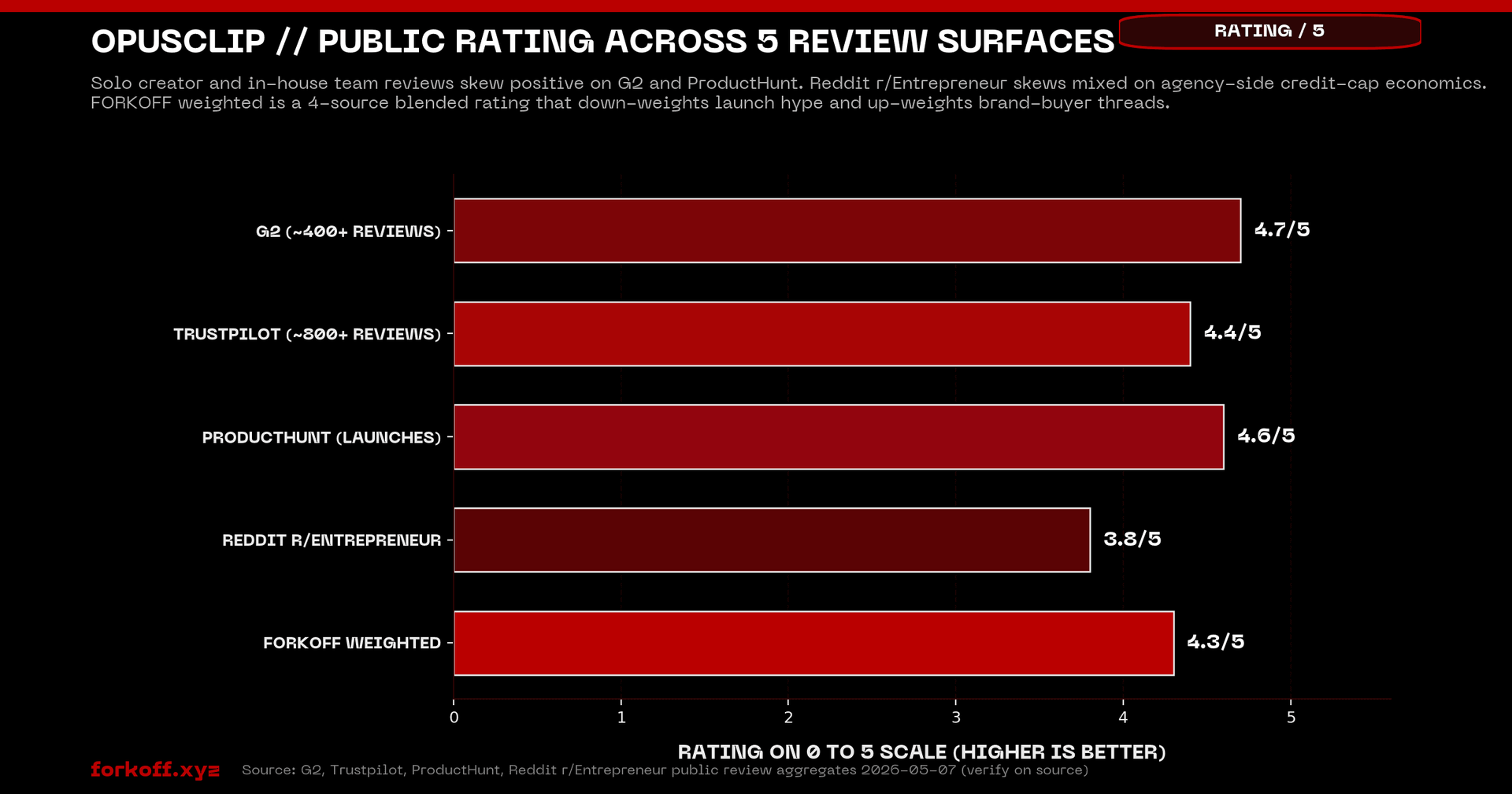
The G2 rating leads the category for AI clipping tools. Most reviewers are solo creators or small in-house teams running their own editorial pipeline, which is the lane OpusClip is built for and the lane where the product performs well. Trustpilot reviews skew toward billing and credit complaints because consumer-side dissatisfaction tends to surface there before G2. Reddit threads in r/Entrepreneur are the most useful for evaluating multi-clipper team economics: the per-seat plus per-credit pricing compounds in ways the headline price does not show.
OpusClip public review surfaces (verify on source 2026-05-07)
| Source | Rating | Review volume | Sentiment summary |
|---|---|---|---|
| G2 | 4.7/5 (approx) | 400+ reviews | Strong on clip selection and time-saved, gaps on credit accounting and export QA |
| Trustpilot | 4.4/5 (approx) | 800+ reviews | Praise on auto-reframe and captions, complaints on credit walls and billing surprises |
| ProductHunt | 4.6/5 (approx) | Multiple featured launches | Strong launch sentiment, AI clip selection drives upvote commentary |
| Reddit r/Entrepreneur | 3.8/5 (approx, mixed) | High thread volume | Solo creator positive, agency-side mixed on credit caps and per-seat economics |
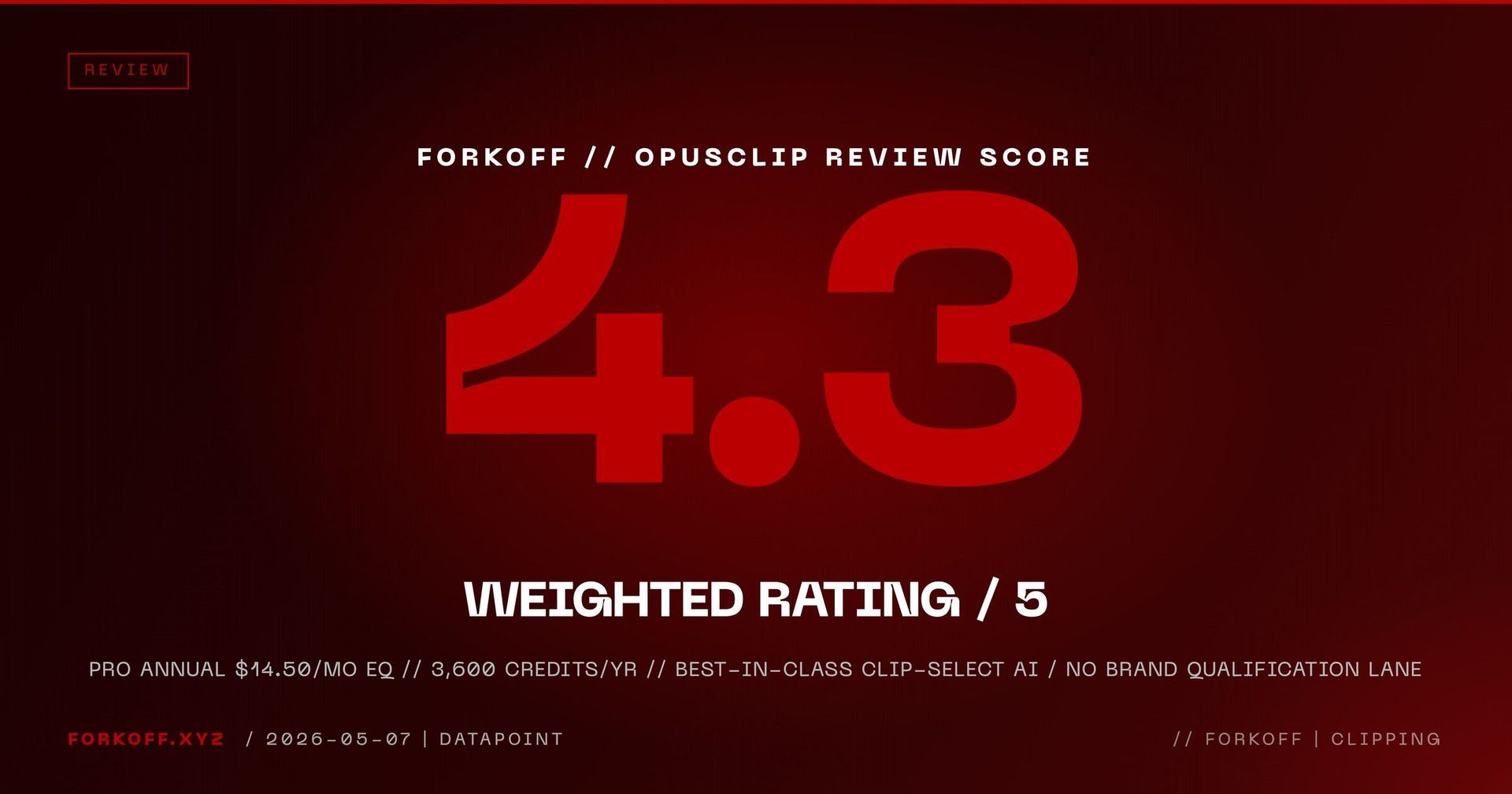
Ratings approximate, sampled 2026-05-07 from public review surfaces. FORKOFF weighted score 4.3/5 blends 4 sources with creator-launch reviews down-weighted.
ICP fit grid
Best for
- Solo clippers and in-house creators with 1-3 shows on a flat tool budget
- Founders clipping their own podcast back catalog who already know which beats to lift
- Agencies operating multi-show schedules with clear editorial direction
- Clippers who want AI B-roll and auto-reframe without a manual editing pipeline
- Teams needing 20+ language caption coverage out of the box
- Clippers finishing in Adobe Premiere or DaVinci who need editor-export support
Not for
- Brands buying qualified views, not credit packs
- Treasury teams needing a per-view audit ledger with reason codes on rejection
- Web3 protocols requiring sanctioned-region geo exclusions enforced at brief acceptance
- Buyers who refuse to operate the editing tool themselves
- Networks needing a managed strategist to brief the show and qualify the output
- Brands shipping high-volume daily clips that hit the credit cap mid-month
The lane-shift framing
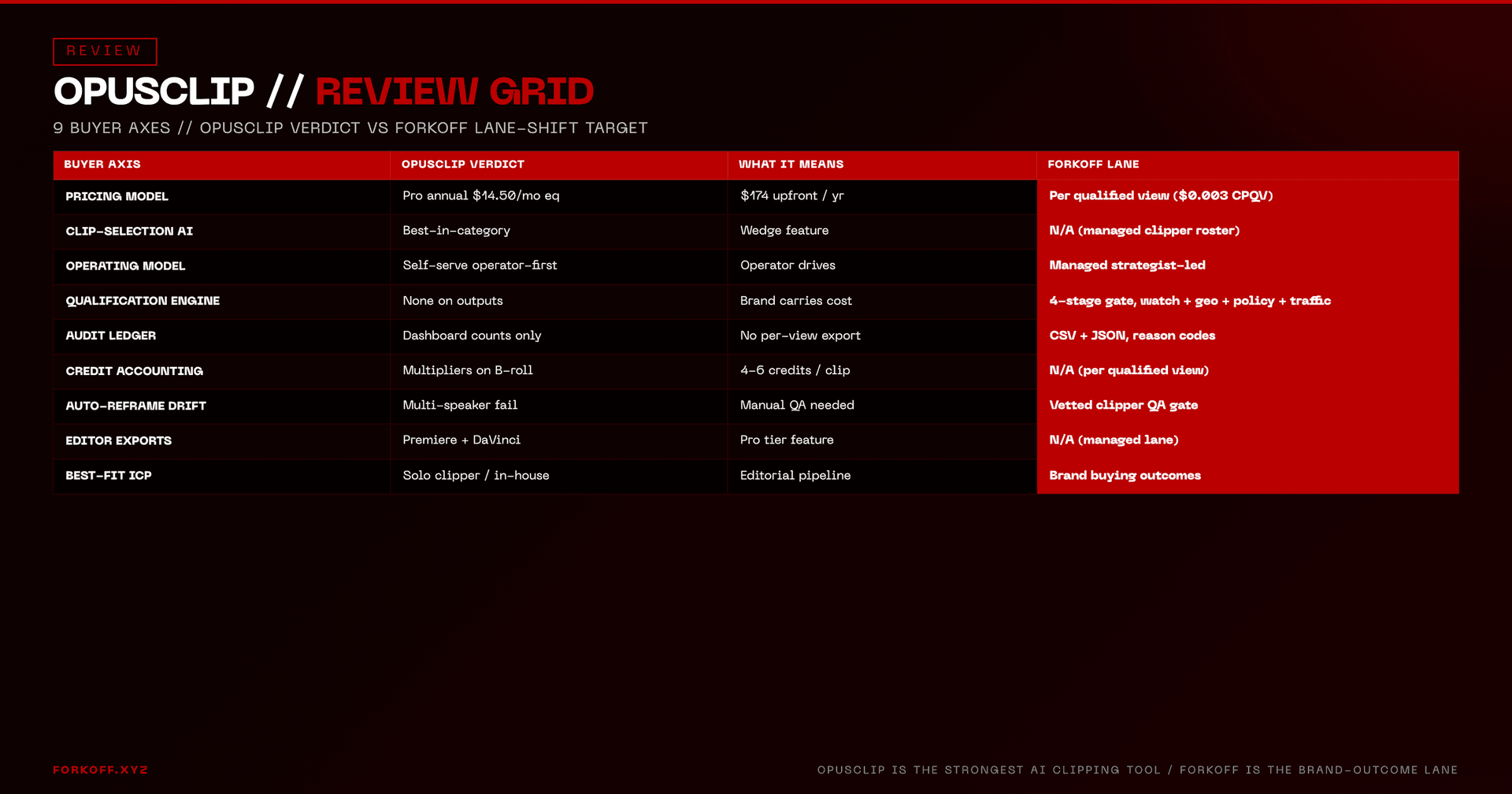
OpusClip is software you run. FORKOFF is a campaign someone runs for you. They are not direct substitutes and they sit in different lanes. OpusClip's lane is the AI clipping tool. The wedge is clip-selection quality on long-form sources. The pricing is denominated in credits and seats. The operating model is self-serve: the operator drives the editorial pipeline, the tool ships the assist. FORKOFF's lane is the managed clipping campaign. The wedge is the per-view qualification engine and the exportable per-view ledger. The pricing is denominated in qualified views (CPQV at $0.003 per view passing four checks: watch-time, policy, geo, traffic-validity) rather than in credits or seats. The operating model is managed: a strategist briefs the show, vetted clippers ship the clips (vetted on prior qualification rates, not raw view counts), the qualification engine runs every view, and the per-view ledger ships exportable to CSV and JSON for treasury reconciliation. FORKOFF doesn't replace OpusClip. The two surfaces compose when used in their own lanes.
Source: FORKOFF Clipping operations playbook + OpusClip public pricing pages, sampled 2026-05-07
Most of my streams run 6 to 8 hours, and after each one I want to turn them into highlights for YouTube Shorts and TikTok. But in reality, I forget where the good moments even happened, scrubbing through hours of nothing.
Verdict and recommendation
OpusClip is well-built for its lane and it is the right pick for the buyer it is built for. If you are a solo clipper, an in-house creator, or a small team running a multi-show editorial pipeline with clear direction, OpusClip Pro annual at $14.50/month equivalent is the recommendation. The clip-selection AI compresses the source-to-shortlist step that otherwise eats hours per source. Auto-reframe and captions ship in the base product. Editor exports keep the workflow flexible.
Two practical caveats. First, model your credit consumption against the realistic burn including AI B-roll multipliers, not against the headline credit count. If you ship branded clips with B-roll on every clip, the realistic burn is 3-4x the headline and the tier-up calculus shifts. Second, plan for manual QA on every export, especially on multi-speaker formats where auto-reframe drift is most pronounced.
If you are a brand buying outcomes, the lane shift is the right call. The per-seat per-credit economics do not produce the per-view audit ledger your finance team needs. The operating model assumes you run the campaign. The qualification layer is brand-side. A managed agency built for the outcome lane (such as FORKOFF) is the structural fit.
If your evaluation is between OpusClip and FORKOFF specifically, /vs-opusclip walks the line-by-line comparison. The /opusclip-review landing page covers the OpusClip assessment in shorter commercial-intent form. For a category-wide ranking of brand-side outcome agencies, /best-clipping-agency ranks the available options. For the category overview, /clipping-agency defines the agency model and the buyer it is built for.

Frequently Asked Questions
Yes. OpusClip is a well-funded AI clipping tool with strong category presence, a public review footprint across G2 (~400+ reviews) and Trustpilot (~800+ reviews), and a clear product roadmap. The platform ships browser-based AI clip selection, auto-reframe, and multi-language captioning with predictable subscription tiers. Legit and well-built for the lane it owns. The category-fit gap surfaces only on brand-side outcome buying where no per-view qualification layer exists. Legit and right-for-your-use-case are different questions: OpusClip is legit and the use-case fit depends on whether you are operating the tool or buying outcomes.