Why 20,000 YouTube Subs Mean Nothing in 2026 (And What Replaces Them)
20K YouTube subs are meaningless in 2026. The QUALIFIED VIEW replaces them. FORKOFF shipped 1.19M in 13 days at $0.003 each. The 5-step PERMANENT DISTRIBUTIO...

Sub count is a 2018 metric. QUALIFIED VIEW is the 2026 unit.
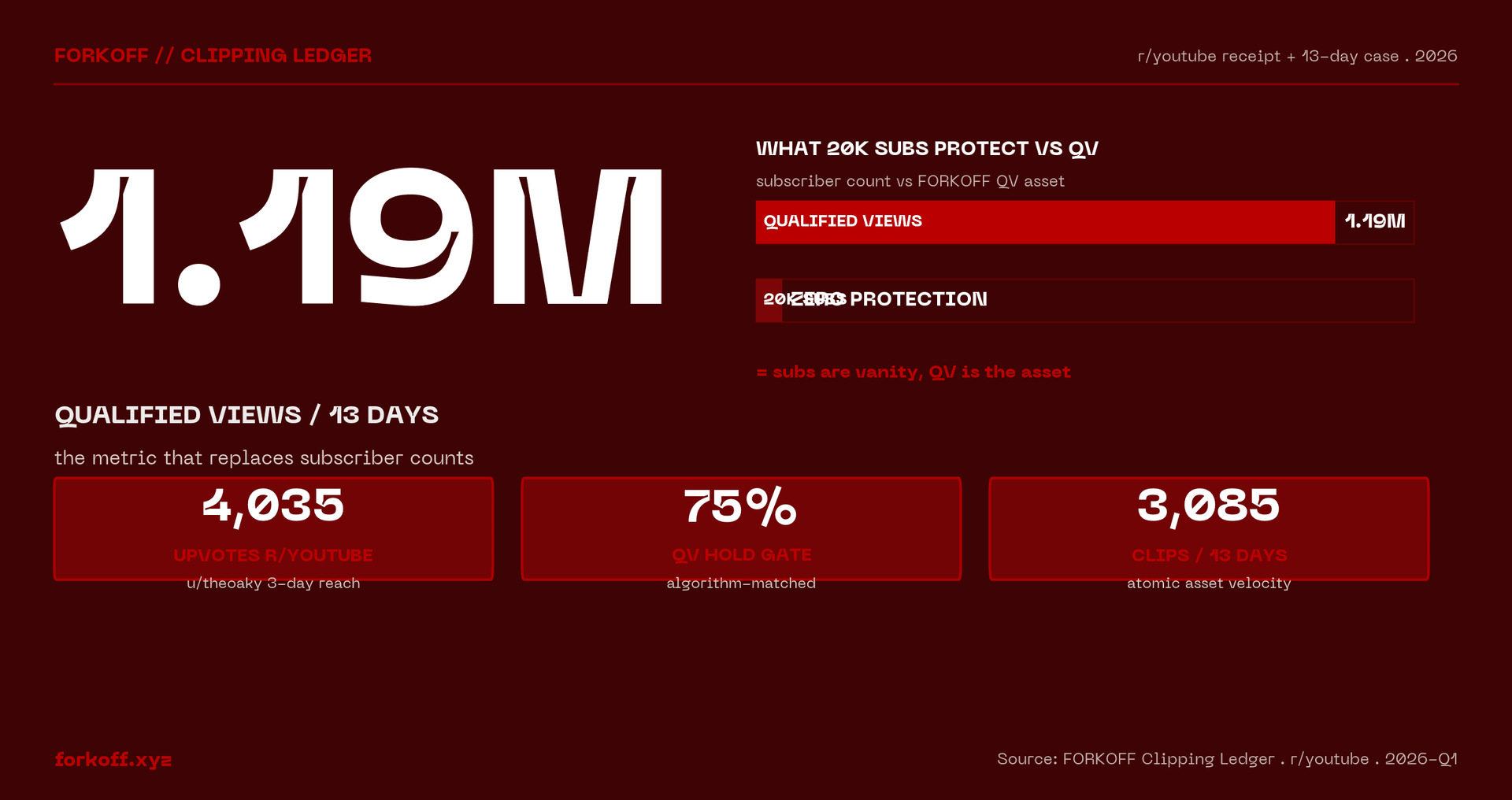
On April 23, 2026 a single r/youtube thread titled "Wtf? 20k+ subs btw" cleared 4,035 upvotes and 461 comments inside three days. The actual complaint: a 20,000-subscriber channel got held hostage by a platform check, and not a single one of those subscribers shielded the creator from it. The replacement metric for subscriber count is the QUALIFIED VIEW: a watch held to 75% by an algorithm-matched viewer on a feed where they can act. FORKOFF has shipped 1.19M of them in 13 days at $0.003 each. This post unpacks the 5-step founder-side migration to a PERMANENT DISTRIBUTION ENGINE.
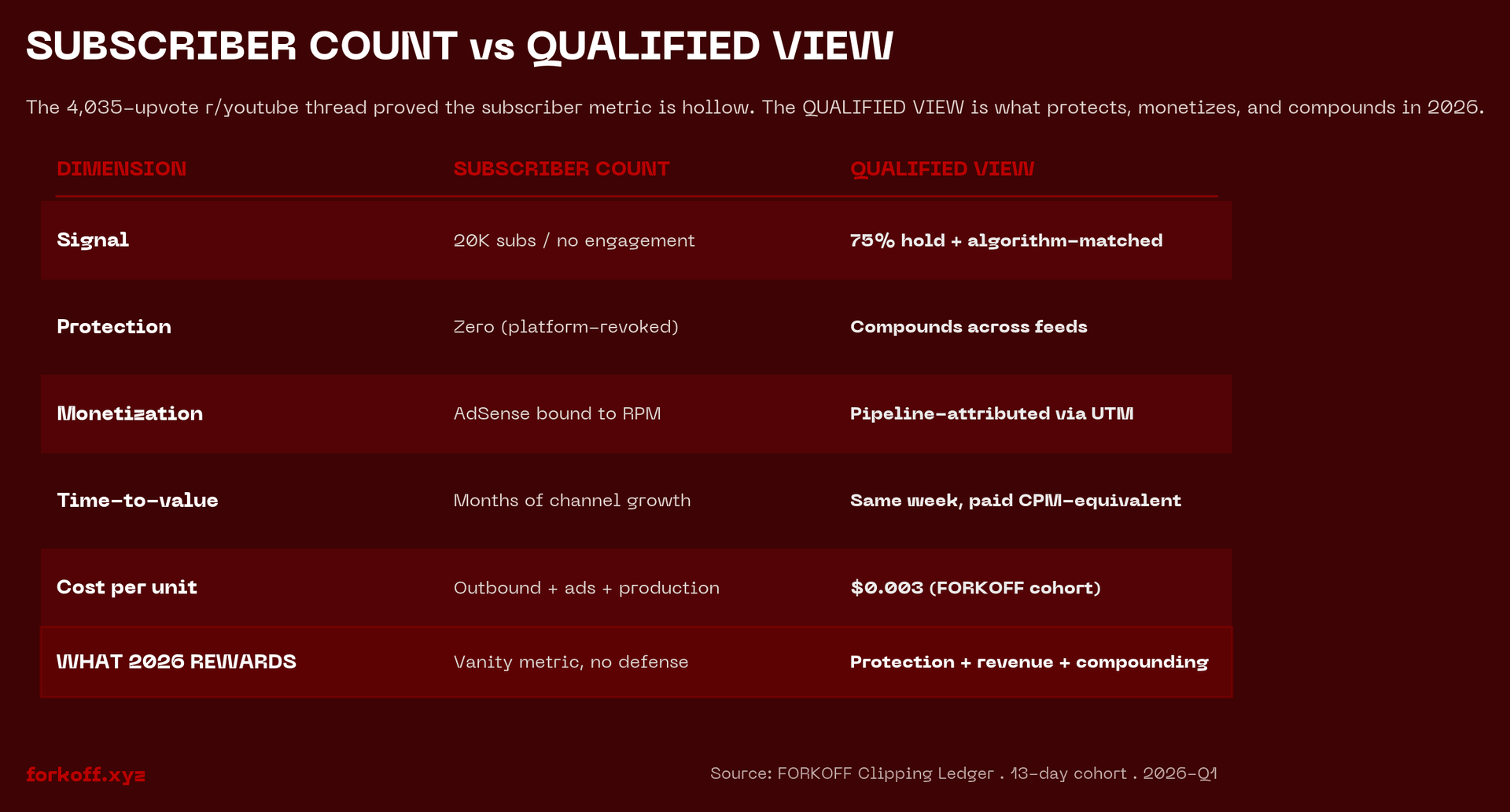
1. The 4,035-upvote receipt: 20K subs, zero protection
A user named u/theoaky posted a screenshot to r/youtube on April 23, 2026 with a four-word title: "Wtf? 20k+ subs btw." Three days later the thread sat at 4,035 upvotes and 461 comments. The image showed a channel-feedback notification freezing a 20,000-subscriber channel until the creator submitted a government ID. The top comments framed the receipt: "Literally holding your channel hostage so they could steal and sell your identity." "The more influence you have, the more they wanna know who tf is behind it."
That is the cultural moment. A 20,000-subscriber count, in 2026, is not a moat. It is not even a status floor. It is a number on a dashboard that does nothing to protect view counts, payouts, or basic platform access when YouTube decides to gate, throttle, or split your distribution.
The creators in the comments are not arguing about whether 20,000 subs is impressive. They are agreeing, en masse, that 20,000 subs no longer means anything operational. That is the signal worth riding.
Wtf? 20k+ subs btw

2. What subs were supposed to mean (and why the proxy broke)
In 2018, a YouTube subscriber was a distribution unit. Hit subscribe and the next upload arrived in your feed. Build 20,000 subs and the next upload arrived in 20,000 feeds, modulated by activity but anchored by intent. The sub list was the only owned distribution surface a creator had inside a rented platform. It was the proxy for trust, for compounding leverage, and for the conversation between a creator and the network they had assembled.
That proxy broke. By 2026, 74% of Shorts views come from non-subscribers, and the home feed is curated by a recommendation system that asks one question on every render: does this person want this clip right now. Subscriber identity is one input among many. It is not the deciding input.
A 20,000-sub channel posting a Shorts clip in 2026 reaches an audience that is statistically dominated by viewers who have never heard of the channel. The bell icon does not gate the feed. The algorithm does. The list does not open the inbox. The cluster does. Outlierkit's 2026 algorithm change log tracks the shift across the February recency update and the AI-clustering rework that followed.
3. The algorithm split that hollowed out the sub
The other half of the collapse is the format split. YouTube now runs Shorts and longform as separate distribution economies, with separate ad inventories and separate revenue pools. Shorts RPM in 2026 sits between $0.01 and $0.07 per 1,000 views for most creators. Longform RPM stays in the $4 to $15 band on the same channels. The numbers are not in the same league. They are in different sports.
The cruel mechanic for the 20K-sub creator: most of those subs were earned on Shorts. They will not watch a 12-minute longform upload. The algorithm knows. The recommendation system de-ranks the longform piece because the cluster does not engage. The creator is left with a sub list that compounds nothing, on a longform feed the platform itself is quietly killing, with monetization rates that no longer fund the production cost of the content the subs supposedly subscribed to.
This is the underwriting reason the r/youtube thread cleared 4,000 upvotes. The viral framing is "ID check held my channel hostage." The viral logic is "I have 20,000 subs and none of them save me from anything." The number on the channel page no longer maps to anything the creator can defend, monetize, or compound.

Audit your last 90 days of YouTube clips for free
Free FORKOFF Clipping Ledger audit. We compute your baseline cost per qualified view, segment by hook family, and surface the cohort that compounds.

4. What replaces subs: QUALIFIED VIEW + atomic asset velocity
The replacement unit is the QUALIFIED VIEW. A qualified view is a watch held to at least 75% completion, by a viewer the algorithm has clustered into the topical surface, on a feed where the viewer can act (visit profile, click bio, search the brand). Three properties, all required. Two out of three is noise. We unpacked the full definition and the four-step QVA framework in Qualified Views: The Content Metric That Predicts Pipeline, the unit that survives a CFO question.
The qualified view replaces sub count as the headline metric because it does the one thing the sub list stopped doing: it correlates with downstream action. Profile clicks, branded search, retained followers, deal flow. None of these correlate cleanly with sub count in 2026. All of them correlate with qualified-view yield.
Atomic asset velocity is the second variable. The 20K-sub creator is publishing one longform piece per week and watching the views drift down a falling curve. The clip-first creator is publishing 30 to 50 distribution assets from the same one-hour input and watching each clip enter its own algorithmic cluster. The volume is not the point. The atomicity is. Each clip is its own distribution probe. The bad ones die in 12 hours. The good ones compound for months.
FORKOFF Clipping Ledger: 13 days, 3,085 clips, 1.19M qualified views
Across 13 active distribution days on a single managed-clipping engagement, the FORKOFF Clipping Ledger logged 3,085 clips, 1.19M qualified views, and 27 paying subscribers at $50 per month, for $1,290 MRR. Cost per qualified view: $0.003. The unmanaged industry average sits between $0.01 and $0.10 per qualified view. We are operating 3x to 33x cheaper at the unit level, on a metric that maps to deal flow rather than dashboard vanity. This is the receipt for the replacement system: every clip is an atomic distribution asset, every view is filtered by hold rate and audience match, every dollar is benchmarked against a unit cost the boardroom can defend.
Source: FORKOFF Clipping Ledger 2026-Q1
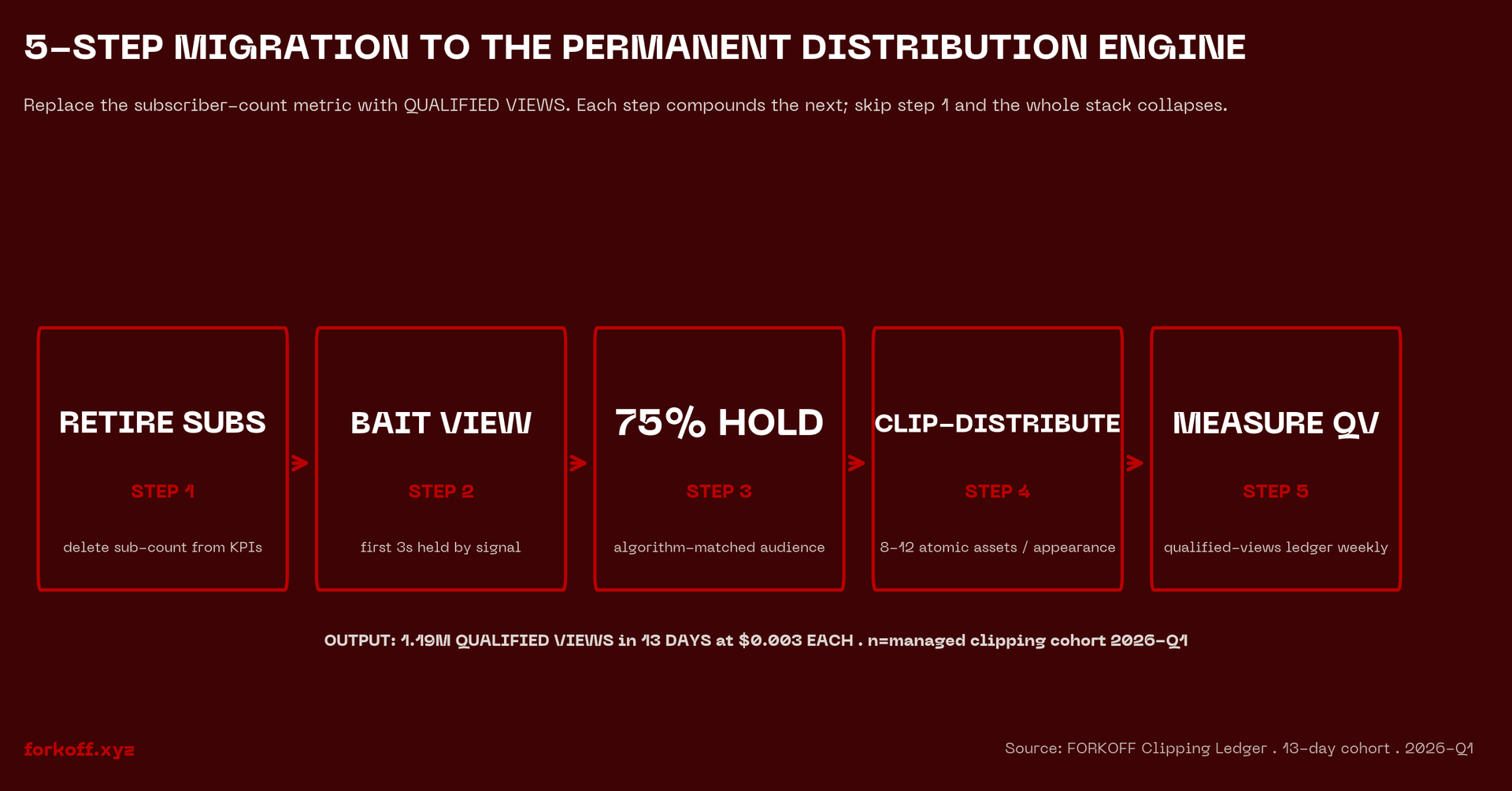
5. The PERMANENT DISTRIBUTION ENGINE
The system that produces those numbers is what we call the PERMANENT DISTRIBUTION ENGINE. The name is not decoration. It is a load-bearing claim about what the FORKOFF clipping system does at the operator level.
Three properties define the engine:
- It converts every founder appearance into 30 to 50 atomic distribution assets, each tuned to a single platform's algorithmic surface.
- It keeps those assets earning past the 48-hour content-death window that kills almost every long-form upload.
- It compounds. The cluster the algorithm built around clip 47 makes clip 312 cheaper to distribute, because the platform now knows who to feed it to.
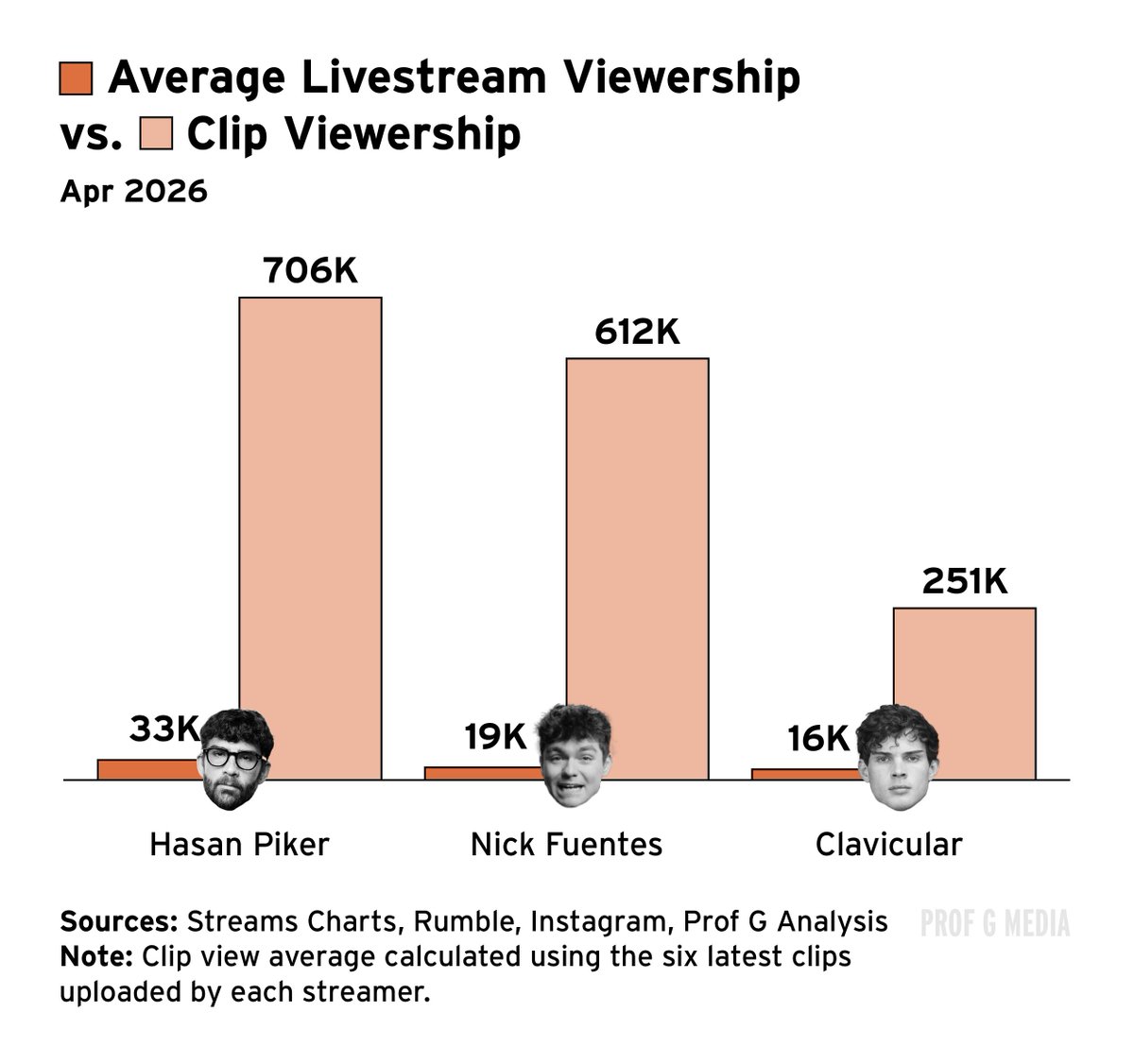
The macro precedent is OpenAI's reported $200M acquisition of TBPN, a daily live show with 7,000 live viewers and 257,000 average clip views, clip distribution priced 37x higher than the show itself. We unpacked the deal and the operator math in The Clip Economy: OpenAI's $200M Podcast Bet Rewires Attention. The buyer was an AI lab, not a media company. The asset they bought was the clip distribution surface, not the show.
The 20K-sub creator does not have an engine. They have a list. The list does not compound. Lists decay. Engines compound.
6. The 5-step founder-side migration
Migrating off the sub-count metric is mechanical. The discomfort is editorial, not technical. Five steps, in order:
Step 1. Retire sub count from your weekly report. Stop opening the Studio dashboard with subscriber numbers as the first line. Replace it with qualified views and profile-click rate. Sub count belongs in the same column as raw impressions: a vendor-owned vanity stat that does not map to a decision your team can make.
Step 2. Audit every long-form session for clip yield. Every podcast, panel, founder interview, and demo recording is a raw material input. The output unit is clips, not episodes. A two-hour podcast that yields three clips is a low-yield asset. A two-hour podcast that yields 40 clips with 8 to 12 strong hooks is a high-yield asset. Score the input by output, not by runtime.
Step 3. Cut 30 to 50 distribution assets per founder appearance. This is the specific operator number. We see compounding kick in around 30 clips per appearance and saturate around 50. Below 30 the algorithm does not have enough variance to cluster the founder's voice. Above 50 you start cannibalizing your own retention. The 30-to-50 band is where the engine actually engages.
Step 4. Run the algorithm on the clip, not the channel. The clip enters the feed as its own distribution probe. The channel page is the receipt, not the surface. Treat hooks, captions, on-screen text, and duration as the unit of optimization. The channel can stay quiet for a month and still earn millions of qualified views, because the work is happening at the clip level. Marketing Agent's 2026 format-balance analysis measured 41% faster channel growth on accounts running clip-first vs single-format strategies.
Step 5. Measure deal flow, not vanity. Deal flow shows up as profile-click rate, branded search, inbound DMs, partner replies, and pipeline. Sub count shows up as a number that flatters the slide deck. Pick one to optimize. Most teams pick wrong because the wrong one is louder.
The migration takes a quarter to install and another quarter to compound. It is not a content strategy. It is a measurement-first operating change that the content strategy follows. We mapped the same shift for the founder-voice surface in Founder-Led Content Marketing 2026: AI Cannot Fake The Voice, where the same retire-vanity-then-rebuild logic applies on the long-form side.

Ed Elson
@edels0n
Clips are no longer the byproduct of the main product — they’re the main product. No matter the size of the show, they drive the ultimate reach 👇
7. The pricing reality: clips beat subs at every altitude
The pricing math is what makes the migration economically obvious. Thirty to fifty distribution assets per founder appearance, distributed across YouTube Shorts, TikTok, Instagram Reels, X, and LinkedIn, will out-reach a 20,000-subscriber list every single week. The reach is wider, the algorithmic surface is broader, and the unit cost per qualified view is, in our roster, an order of magnitude lower than the alternatives.
If you are running this in-house, the DIY clipping stack lands around $140 per month plus 8 to 12 hours of weekly operator time. If you are running it as a managed engagement, pricing sits in the $4K to $12K per month band depending on volume and editorial complexity. Either path is cheaper than the unmeasured longform churn the sub-count creator is funding by default.
8. The bottom line
The viral comment is the operator read in plain language. Sub count, on a rented platform, in a 2026 algorithmic split, does not protect anything. It does not compound. It does not pay rent. It does not earn the next view. The thing that does all four is a clip-first system that produces qualified views at a measurable unit cost.
That system is the PERMANENT DISTRIBUTION ENGINE. The 20K-sub creator does not have one. The clip-first founder, working with the FORKOFF Clipping service, does. The math is settled. The migration is the hard part.
If you want the engine installed, that is what we do at FORKOFF.
Audit your last 90 days of YouTube clips for free
Free FORKOFF Clipping Ledger audit. We compute your baseline cost per qualified view, segment by hook family, and surface the cohort that compounds.
20K subs, qualified views, and the engine that replaces them
Three reasons. First, 74% of YouTube Shorts views come from non-subscribers, so the bell icon no longer gates the feed. Second, YouTube now runs Shorts and longform as separate distribution economies with separate algorithms, so a Shorts-built sub list does not engage with longform uploads. Third, the home feed itself is a recommendation surface where subscriber identity is one input among many, not the deciding input. A 20,000-sub channel posting today reaches an audience statistically dominated by viewers who have never heard of the channel.
A qualified view is a watch held to at least 75% completion, by a viewer the algorithm has clustered into the topical surface, on a feed where the viewer can act (visit profile, click bio, search the brand). Three properties, all required. FORKOFF tracks qualified views because they correlate with downstream action (profile clicks, branded search, deal flow). Subscriber count, in 2026, does not. Full definition and the 4-step QVA framework live at forkoff.xyz/blog/clipping/qualified-views-metric.
The PERMANENT DISTRIBUTION ENGINE is the FORKOFF system that converts every founder appearance into 30 to 50 atomic distribution assets, keeps those assets earning past the 48-hour content-death window, and compounds the algorithmic cluster around them. The receipt: 3,085 clips, 13 days, 1.19M qualified views, $1,290 MRR, $0.003 cost per qualified view. The engine compounds where the subscriber list decays.
No. Longform is the raw material the engine eats. The shift is to stop measuring success at the longform layer (sub count, episode views) and start measuring it at the clip layer (qualified views, profile-click rate, branded search lift). One two-hour podcast that yields 40 clips with 8 to 12 strong hooks is doing the job. One two-hour podcast that yields three clips and 200 episode views is not.
30 to 50 distribution assets per appearance. We see compounding kick in around 30 clips per appearance and saturate around 50. Below 30 the algorithm does not have enough variance to cluster the founder's voice; above 50 you start cannibalizing your own retention. The 30-to-50 band is where the engine engages.