Best AI Video Editor 2026: 9 Tools Ranked Honestly
Compare the 9 best AI video editors of 2026 on pricing, qualified-view economics, audit ledger, and ICP fit. Apply now to test the managed lane.

TL;DR
The best AI video editor of 2026 is the one that fits the lane you are actually in. Solo clippers editing their own back catalog get the most from OpusClip and Submagic. Brands buying outcomes get more from a managed clipping operator with a qualified-view denominator. The nine tools below are ranked on six public axes (pricing transparency, qualified-view economics, per-platform watch-time tuning, audit ledger, brand-safety policy, ICP fit), scored honestly, with the lane-shift point called out.
Most "best AI video editor" rankings are listicles written by the tools themselves, putting themselves at #1 with a thin disclosure block buried below the fold. This one is different. FORKOFF runs a managed clipping operation, not an AI editor. We compare nine AI editors on the criteria a buyer actually uses, name the spots each tool shines, and call out the point where AI tools stop being the answer and a managed lane takes over.
What makes a good AI video editor in 2026
The 2024 criteria were "fast captions, viral score, vertical export." Every tool ships those now. Commodity. The 2026 criteria are different.
Six public axes that separate the field:
- Pricing transparency. Per-month cost visible without a sales call? Export limits, watermark removal, and seat counts disclosed up front?
- Qualified-view economics. Does the tool surface the watch-time denominator (full-watches vs three-second pings) or only the gross view counter?
- Per-platform watch-time tuning. Does the AI cut differently for TikTok (3-second hook), Shorts (8-second retention curve), and Reels (15-second arc), or ship one universal vertical export?
- Audit ledger. Can you export per-clip performance as CSV/JSON for finance, or is the dashboard a vanity counter?
- Brand-safety policy. For regulated brands (finance, health, web3), is there a written policy on what creative the tool will and will not generate?
- ICP fit. Solo clipper, in-house team, agency, or brand buying outcomes. The right tool depends on the lane.
We score each tool strong / partial / absent on each axis, then call the lane-shift point. Every tool below has been tested against its own marketing claims.
The 9 best AI video editors of 2026
1. OpusClip: strongest solo-clipper UX, weakest at scale
Pricing: Free tier, then $15 to $99 per month. Detailed breakdown in the OpusClip pricing page.
Best for: Solo clippers editing their own podcast or stream library.
Verdict: The best UX on this list for one human at a keyboard. Hits a wall the second you need brand-side qualification.
OpusClip's Curation AI has the highest hit rate at picking quotable moments from long-form video, in our testing. The AI Reframe tool tracks faces and graphics through the cut, and the Brand Templates feature is genuinely useful for solo clippers who want consistent intros and outros.
Where it stalls: the per-platform watch-time tuning is one-size-fits-all (vertical 9:16 with a single hook style), the dashboard reports raw view counts only, and there is no audit ledger you can hand to finance. For a solo clipper this does not matter. For a brand running outcome-priced campaigns it is the entire problem. Read the full OpusClip review for the per-feature breakdown, or the OpusClip vs FORKOFF comparison for the lane-shift specifics.
Score: Pricing transparency strong, Qualified-view economics absent, Per-platform tuning partial, Audit ledger absent, Brand-safety policy partial, ICP fit (solo clipper) strong.
2. Submagic: caption king, retention question mark
Pricing: $16 to $69 per month. Full breakdown in the Submagic pricing page.
Best for: Clippers and creators who want broadcast-grade captions without manual tweaking.
Verdict: Best caption engine on this list. Cuts and reframing are weaker than OpusClip; retention math is invisible.
Submagic's caption styles (the bouncing word effect, the keyword highlights, the emoji burns) became the default look for vertical video in 2024 and most of the field is still copying them. The AI B-roll generator is good. The Magic Templates save hours per week for clippers who run consistent visual systems.
Where it stalls: the cut detection is mid-tier (more false positives than OpusClip), there is no built-in qualified-view tracking, and the export lock-in (paid plan required for HD downloads above 30 minutes per month) catches teams off guard. The full Submagic review walks through the gotchas. The vs-Submagic comparison covers the managed-lane shift.
Score: Pricing transparency strong, Qualified-view economics absent, Per-platform tuning strong (caption side only), Audit ledger absent, Brand-safety policy absent, ICP fit (creator + clipper) strong.
3. Captions AI: talking-head specialist, niche but excellent
Pricing: $9.99 to $39.99 per month. Detailed breakdown in the Captions AI pricing page.
Best for: Founders and clippers building talking-head content (selfie-style, single speaker, vertical).
Verdict: The best AI eye-contact, lip-sync, and AI-Twin features on the market. Outside the talking-head lane it is underpowered.
Captions AI built the category for AI-Eye-Contact (turn a script-reading speaker into a camera-locked one) and AI Twin (clone yourself for B-roll). For founders shipping daily talking-head clips, nothing else on this list matches the output quality. The Composer template engine is fast.
Where it stalls: it is not built for podcast or stream clipping (no long-form ingestion), the watch-time data is platform-side only, and the brand-safety policy is not published for regulated brands. The Captions AI vs FORKOFF comparison covers the lane-fit details.
Score: Pricing transparency strong, Qualified-view economics absent, Per-platform tuning partial, Audit ledger absent, Brand-safety policy absent, ICP fit (talking-head founder) strong.
4. Klap: fastest free-tier output, ceiling hits early
Pricing: $29 to $79 per month. Free tier available.
Best for: Clippers testing AI-clip output without committing budget.
Verdict: Fastest path from upload to first export. Quality plateau hits inside the second week of use.
Klap's auto-clip detection is fast and the captions ship in twenty languages out of the box. For a clipper who wants to test the category before paying anything, the free tier is the lowest-friction entry point on this list. The interface is clean.
Where it stalls: the cut quality regresses on long-form content (over 90 minutes), there is no team plan that makes sense for agencies, and the watch-time tuning is generic vertical export. The Klap vs FORKOFF comparison lays out where Klap users typically migrate.
Score: Pricing transparency strong, Qualified-view economics absent, Per-platform tuning absent, Audit ledger absent, Brand-safety policy absent, ICP fit (testing-budget clipper) strong.
5. Vizard: best free tier, ad-supported friction
Pricing: Free tier with watermarks, then $19 to $59 per month.
Best for: Early-stage clippers and educators on a zero budget.
Verdict: The most generous free tier on this list. Watermark removal and HD export gated behind paid tier as expected.
Vizard ships caption styles, scene detection, and vertical export on the free plan, which makes it the lowest-cost entry point for anyone testing the AI-clipping category. The 8 GB upload limit covers most podcast episodes. The interface is straightforward.
Where it stalls: the AI cut detection picks up filler moments more often than OpusClip or Submagic, the brand templates are basic, and there is no audit data exposed at any tier. The Vizard vs FORKOFF comparison covers the upgrade path most teams take.
Score: Pricing transparency strong, Qualified-view economics absent, Per-platform tuning absent, Audit ledger absent, Brand-safety policy absent, ICP fit (zero-budget educator) strong.
6. Munch: multi-platform repurposing, content-marketer angle
Pricing: $49 to $228 per month.
Best for: Content marketing teams repurposing one long-form asset into many channel-specific clips.
Verdict: Strong category-tagging and SEO-keyword extraction. Per-clip cost is the highest in the field.
Munch's pitch is content-strategist-grade insights: it analyzes the source video, tags trending topics, and surfaces the moments most likely to drive traffic on each platform. For an in-house content team that is already running a weekly podcast or webinar, the keyword and trend data alone can justify the price.
Where it stalls: the price floor ($49 entry) is high for a tool that still leaves the brand to do qualification, the team-seat math gets expensive fast, and there is no qualified-view denominator. The Munch vs FORKOFF comparison covers the in-house-vs-managed math.
Score: Pricing transparency strong, Qualified-view economics partial, Per-platform tuning partial, Audit ledger partial, Brand-safety policy absent, ICP fit (in-house content team) strong.
7. Vidyo.ai: repurposing engine with podcast strength
Pricing: Free tier, then $29.99 to $89.99 per month.
Best for: Podcast clippers who want auto-publishing pipelines.
Verdict: Solid podcast clipping with native publishing integrations. Cuts run shorter than competitors, by design.
Vidyo.ai's autopublish integration (direct push to TikTok, Reels, Shorts, LinkedIn) saves the manual upload step. The clip durations skew shorter (15 to 45 seconds) which fits the 2026 platform algorithms. The Magic Layouts feature handles vertical reframing well.
Where it stalls: the AI cut quality on debate-style podcasts (multiple speakers, fast turn-taking) is weaker than OpusClip, the dashboard surfaces vanity views only, and there is no brand-safety contract for regulated verticals. The Vidyo vs FORKOFF comparison covers the regulated-brand gap.
Score: Pricing transparency strong, Qualified-view economics absent, Per-platform tuning partial, Audit ledger absent, Brand-safety policy absent, ICP fit (podcast clipper) strong.

Hridoy Rehman
@hridoyreh
3. Free Online Tools My developer built 10 free tools. 3 reasons to make simple free tools: • Get consistent traffic • Get high-quality backlinks • Increase user session time Even AI can't reduce clicks on tools.
8. Spikes Studio: gamified clipping for streamer back-catalogs
Pricing: Free tier, then $15 to $79 per month.
Best for: Twitch and Kick streamers clipping their own VODs.
Verdict: Gamified UX with viral-score predictions. Score reliability is mixed; the underlying cut quality is good for streaming content.
Spikes Studio's "viral score" prediction (0 to 100 per clip) makes the workflow feel like a feedback loop, which is genuinely motivating for streamers who clip their own VODs nightly. The Twitch and Kick integrations pull VODs directly. Caption styles fit the gamer aesthetic.
Where it stalls: the viral-score reliability is hit-or-miss (high scores do not always correlate with platform performance), the dashboard reports raw views, and the brand-side audit features are absent. For Twitch streamers specifically, see the Twitch clipping hub for the managed alternative. The Spikes vs FORKOFF comparison covers where streamers cross over.
Score: Pricing transparency strong, Qualified-view economics absent, Per-platform tuning strong, Audit ledger absent, Brand-safety policy absent, ICP fit (streamer back-catalog) strong.
9. Clipify: agency-tier with creator-economy roster
Pricing: Variable, agency-tier (talk to sales).
Best for: Token launches and creator-economy brands that want a packaged distribution layer.
Verdict: Half tool, half agency. Pricing is undisclosed and the tooling sits behind a managed wrapper.
Clipify ships 3B+ views across 200+ campaigns with a roster that includes BlockDag, Spartans, Sophie Rain, and FouseyTube. The brand-side wrapper handles distribution and the toolset underneath is a clip-generation engine. For web3 launches that want a managed-feel without committing to a true outcome-priced agency, it sits in a hybrid lane.
Where it stalls: the pricing model is not disclosed publicly, the qualified-view denominator is not published, and the audit trail is not exported to brands. The Clipify vs FORKOFF comparison covers the outcome-pricing gap.
Score: Pricing transparency absent, Qualified-view economics absent, Per-platform tuning partial, Audit ledger absent, Brand-safety policy partial, ICP fit (creator-economy brand) strong.
When AI tools hit their wall: the managed-agency lane
Every tool above is designed for the same buyer: one human (a clipper, a creator, a content marketer) at a desk. That buyer is real and the tools serve them well. The problem starts when the buyer is a brand running outcome-priced distribution.
The lane-shift symptoms:
- Dashboard shows 4 million views; finance asks "how many were full-watches?" and there is no answer.
- Campaign runs in 30 countries; brand needs sanctioned-region exclusions and category-specific creative rules; no AI tool publishes a brand-safety contract.
- Invoice for $4,000 says "AI clipping subscription, 5 seats" and the CFO asks "what did we get for it?"; the vanity counter does not translate to spend justification.
- Agency review pulls clip-level performance and asks "why did this one underperform?"; no per-clip reason code, no qualification ledger, no audit trail.
This is the managed lane. Same problem solved by a different vendor type: a clipping agency that prices on qualified views (views that cleared watch-time thresholds, geo filters, brand-safety policy, and traffic-validity checks) instead of raw view counts. Denominator published. Audit ledger exports as CSV. Brand-safety policy is a written contract.
FORKOFF runs that lane. The best clipping agency comparison ranks nine managed operators on the same six axes. The clipping agency vs marketplace breakdown covers the structural difference between managed, marketplace, and DIY-tool lanes.
The lane-shift is not "AI tools are bad." It is "different ICP, different vendor type." Solo clipper edits her own back catalog goes to OpusClip + Submagic. Brand runs a $40K outcome-priced quarterly campaign goes to a managed agency with CPQV pricing. Both correct for their lane.
Anyone else overwhelmed by editing 6–8 hour Twitch VODs into highlights?
I’m a newer streamer and honestly this is the part that’s starting to burn me out a bit. Most of my streams run 6–8 hours, and after each one I want to turn them into highlights for YouTube Shorts / TikTok. But in reality… * I forget where the good… Show more
Industry context
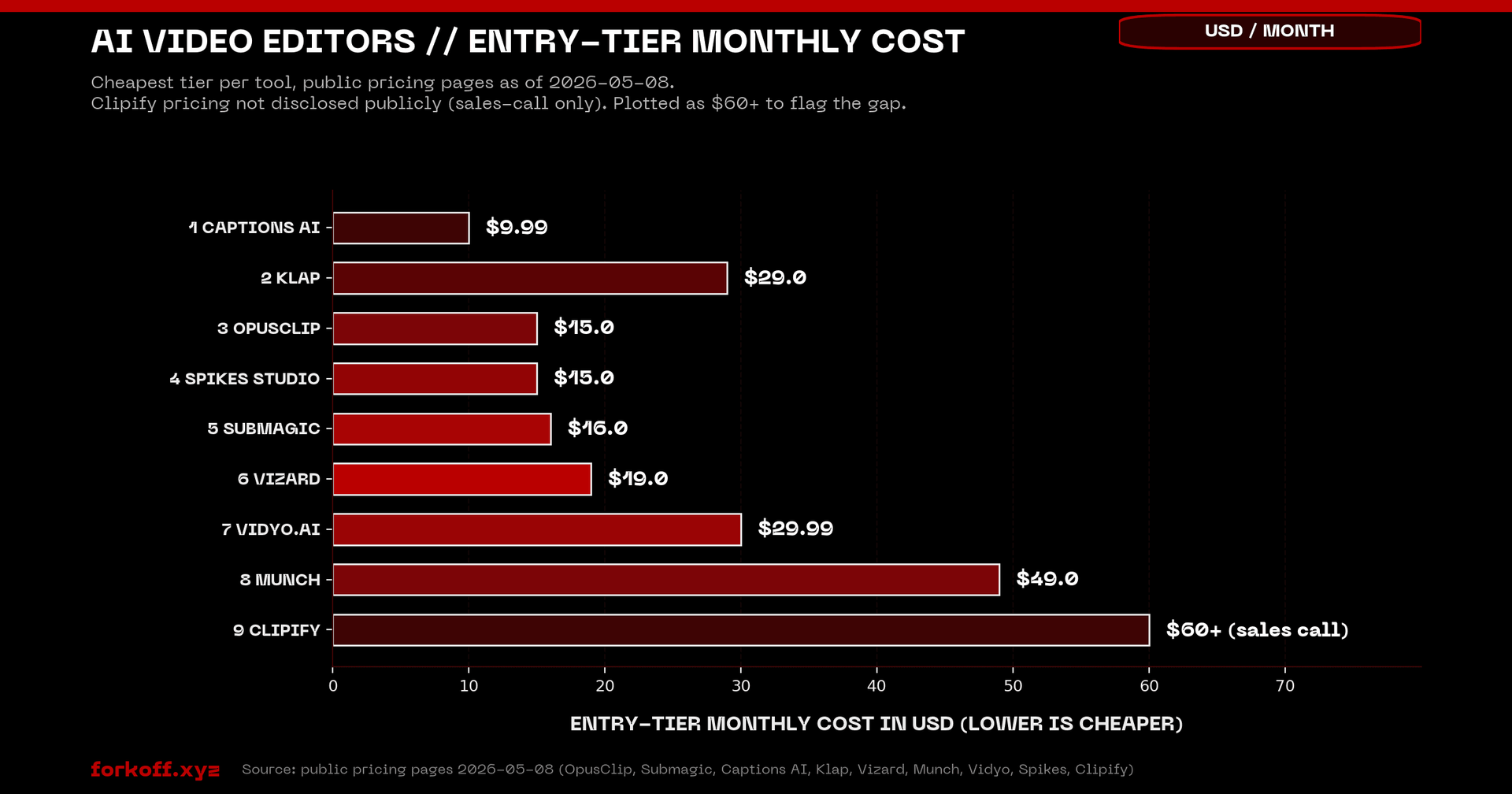
AI video editor pricing pages confirm the public-axis snapshot: Captions AI publishes a $9.99 entry tier, OpusClip and Spikes Studio share a $15 entry, Submagic enters at $16, Vizard at $19, Klap at $29, Vidyo.ai at $29.99, Munch at $49 (with a $228 ceiling), and Clipify routes new accounts through a sales call rather than a public pricing page. Of the nine, only Munch publishes any qualified-view-adjacent insight (category-tag scoring), and none publish a written brand-safety contract for regulated verticals (finance, health, web3, gambling). The gap is the entire reason the managed-lane CPQV model exists.
Source: Public pricing pages and ToS, sampled 2026-05-08
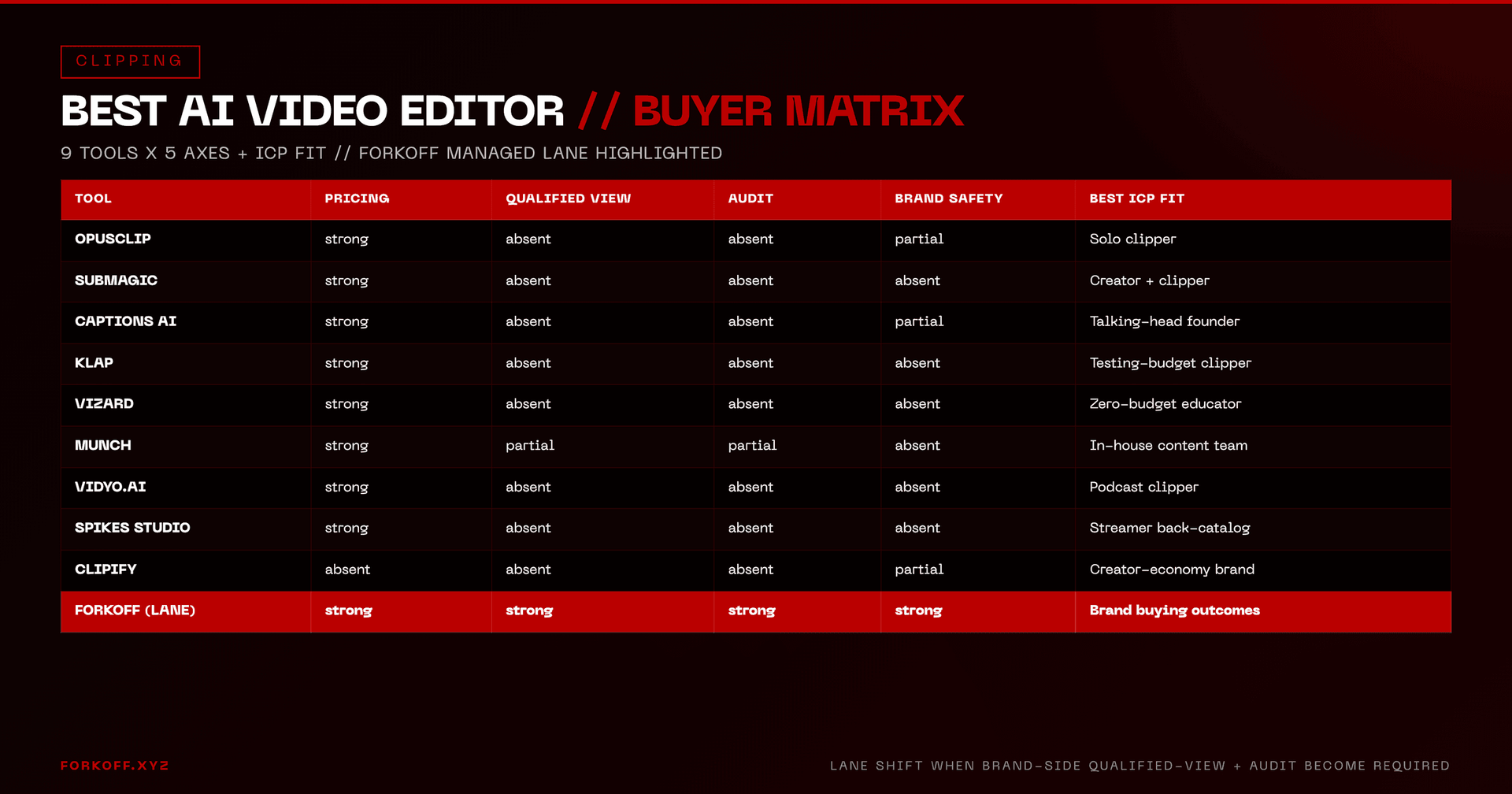
Ranking summary
The full 9-tool plus FORKOFF-lane scorecard, distilled. Every score reflects the public axis as of 2026-05-08. Pricing pages and feature pages are revisited quarterly.
9 AI video editors plus the FORKOFF managed lane, scored on 6 public axes
| # | Tool | Pricing | Qualified-view | Audit ledger | Brand-safety | Best ICP fit |
|---|---|---|---|---|---|---|
| 1 | OpusClip | strong | absent | absent | partial | Solo clipper |
| 2 | Submagic | strong | absent | absent | absent | Creator + clipper |
| 3 | Captions AI | strong | absent | absent | partial | Talking-head founder |
| 4 | Klap | strong | absent | absent | absent | Testing-budget clipper |
| 5 | Vizard | strong | absent | absent | absent | Zero-budget educator |
| 6 | Munch | strong | partial | partial | absent | In-house content team |
| 7 | Vidyo.ai | strong | absent | absent | absent | Podcast clipper |
| 8 | Spikes Studio | strong | absent | absent | absent | Streamer back-catalog |
| 9 | Clipify | absent | absent | absent | partial | Creator-economy brand |
| FK | FORKOFF (managed lane) | strong | strong | strong | strong | Brand buying outcomes |
FORKOFF is not an AI video editor. It is the managed lane the table shifts into when brand-side requirements (qualified-view denominator, audit ledger, brand-safety contract) outgrow what any AI tool ships. Public pricing snapshot: 2026-05-08.
What to do next
If you are a solo clipper or creator editing your own library: pick OpusClip (best UX), Submagic (best captions), or Captions AI (best talking-head). Free tiers cover the first month of testing.
If you are an in-house content team repurposing weekly long-form: Munch and Submagic team tiers handle most workloads. Read the per-tool review pages above before committing.
If you are a brand buying outcome-priced distribution and the AI-tool stack already is not ledger-grade enough for finance: this is the lane shift. The FORKOFF $500 sandbox ships brief-to-live in 48 hours and the qualified-view denominator is exported per clip. The best clipping agency comparison ranks the managed-lane competitors on the same six axes used in this listicle. The podcast clipping and YouTube Shorts clipping hubs cover the per-channel managed playbooks.
This listicle is updated quarterly. Last reviewed: 2026-05-07. FORKOFF authored, FORKOFF self-ranked in the managed lane only (not in the AI-editor field). Verify every line.

Frequently Asked Questions
For solo clippers editing their own podcast or stream library, OpusClip ranks #1 in our testing for cut quality and Brand Templates UX. For caption-heavy vertical video, Submagic ranks #1. For talking-head content (founder selfies, daily LinkedIn videos), Captions AI ranks #1. The 'best' depends on the lane. Brands buying outcome-priced distribution should not use AI tools at all; they should evaluate managed clipping agencies on the FORKOFF best clipping agency comparison.